- What Is A Logo Brief?
- Why Logo Briefs Matter
- Logo Brief Vs Brand Strategy
- Before You Write The Brief
- Business Context And Goals
- Define The Target Audience
- Positioning And Competitors
- Brand Personality And Message
- Existing Identity And Rebrands
- Logo Usage And Deliverables
- Visual Direction And References
- Budget, Timeline And Process
- Feedback And Approval
- Questions To Answer
- Write The Brief Step By Step
- Weak Vs Strong Brief Example
- Logo Brief Template
- How Designers Use The Brief
- Common Brief Mistakes
- Logo Brief Approval Checklist
- Frequently Asked Questions
- Final Thoughts
What Is A Logo Brief?
A logo brief is a short, structured document that gives a designer the context needed to create an appropriate logo. It explains what the business does, who it serves, how it is positioned, what the identity should communicate and where the finished logo must work. It also records practical details such as the project scope, deliverables, deadline, budget and approval process.
The brief is not a drawing request dressed up as strategy. “Use a blue circle with a mountain inside” is a proposed solution, not a useful explanation of the problem. A designer can respond more intelligently to information such as: “We help first-time hikers choose safe, uncomplicated outdoor experiences, and our current identity feels too technical and intimidating.” That statement reveals the audience, the barrier and the desired change while leaving room for professional exploration.
A strong logo design brief creates a shared reference point. When a concept is presented, the client and designer can ask whether it supports the agreed goals instead of relying only on personal taste. This does not remove subjectivity from design, but it gives the conversation a stable center.
A logo brief tells the designer who the business is, whom the logo must reach, what it must communicate, where it must work and how the project will be judged.
Why Logo Briefs Matter Before Design Begins
Logo projects often become difficult before anyone opens design software. The client may be carrying an unwritten picture of the result, while the designer is building a completely different interpretation from a few vague words. Both people can work sincerely and still move in opposite directions because the destination was never made explicit.
Terms such as “modern,” “premium,” “simple” and “bold” are especially risky. A modern identity could mean geometric minimalism to one person, expressive typography to another and a technology-inspired gradient to someone else. A good brief asks what the word means in the context of this business. Does “premium” mean quiet craftsmanship, exclusive access, superior performance or high price? The answer changes the visual strategy.
Clear inputs also reduce unproductive revision cycles. Feedback becomes easier when stakeholders agree on the audience, positioning and success criteria before concepts arrive. Instead of “I do not like it,” a reviewer can explain that a direction feels too playful for the trust-sensitive customer described in the brief. That is feedback a designer can interpret and act on.
The Brief Reduces Decision Waste
A useful brief does not promise that every first concept will be approved. It makes exploration more relevant, feedback more consistent and late-stage surprises less likely.
A logo project gains direction when the team agrees on the problem before discussing the picture.
Logo Brief Vs Brand Strategy Vs Creative Brief
These documents overlap, but they are not interchangeable. Brand strategy defines the larger decisions that shape how an organization competes and communicates. It may include purpose, positioning, audience segments, value proposition, personality and long-term brand architecture. A logo brief uses the relevant parts of that strategy for one visual identity project.
A creative brief is usually broader than a logo brief and may guide an advertising campaign, website, video, packaging range or content project. It often includes a communication objective, a single-minded message, campaign channels and a desired audience response. A logo brief is narrower: it concentrates on the identity mark, its relationship to the wider visual system and the conditions in which it must perform.
Which Document Do You Need?
| Document | Primary Purpose | Typical Scope |
|---|---|---|
| Brand Strategy | Defines the brand's position, audience, promise and long-term direction. | Organization-wide and long-term. |
| Creative Brief | Guides a particular communication or creative assignment. | Campaign, website, video, packaging or another project. |
| Logo Brief | Translates business and brand context into direction for a logo project. | Logo, core variations and agreed identity deliverables. |
| Logo Questionnaire | Collects raw information before the final brief is written. | Questions for the client, founder and key stakeholders. |
A Logo Cannot Carry The Entire Brand Alone
If the project also needs a color system, typography, imagery, templates and detailed guidelines, describe it as a visual identity project rather than hiding the larger scope inside a “logo” request. Our guide to building a visual identity explains how those elements work together.
Before You Write The Logo Brief
Begin by deciding who will provide information and who will make the final decision. In a founder-led business, one person may do both. In a larger organization, marketing, leadership, product and sales teams may each hold different parts of the picture. Collecting their knowledge is useful; giving everyone equal and undefined approval power is not.
Name one project owner. This person gathers internal input, resolves contradictions and gives the designer a consolidated response. Without an owner, feedback can arrive as a collection of competing preferences. The designer then spends time managing organizational uncertainty instead of improving the identity.
Gather the materials that already shape the brand: the current logo, product screenshots, packaging, sales presentations, customer research, brand guidelines, mission statement and examples of real communication. These are evidence. They reveal how the company presents itself today and where the new logo will need to fit.
- Appoint one project owner and identify the final approver.
- List the stakeholders who should be consulted before design begins.
- Collect current brand materials and real customer touchpoints.
- Record the business reason for creating or changing the logo.
- Resolve obvious internal disagreements before they reach the designer.
- Confirm whether the scope is a logo, a visual identity or a wider rebrand.

Explain The Business Context And Project Goals
A designer needs a plain-language explanation of the business before receiving visual instructions. Describe the product or service, the problem it solves, the market it operates in and the reason customers choose it. Avoid copying a formal “About Us” paragraph filled with claims such as quality, innovation and excellence. Those words rarely reveal a meaningful difference.
A useful overview can often be written in three sentences: what the business offers, whom it serves and why its approach is different. For example: “We provide bookkeeping software for independent restaurants. Owners use it to understand daily cash flow without learning accounting terminology. Unlike enterprise tools, the product is designed around the decisions a restaurant manager makes during a shift.” This gives a designer far more direction than “We are an innovative financial technology company.”
Then state the project objective. A new company may need an identity that creates a credible first impression. An established company may be entering a different market, simplifying a complex product portfolio or replacing a mark that fails on digital screens. The project objective should describe the change the logo needs to support, not promise that the logo alone will produce a business result.
Write The Objective As A Change
Use a sentence such as: “The new identity should help us move from being perceived as a small local supplier to a dependable regional partner, without appearing distant or corporate.”
Define The Target Audience Beyond Demographics
“Men and women aged 18–45” is not enough to guide a logo. Demographics describe broad groups, but design decisions become more meaningful when the brief explains needs, expectations and context. Who is choosing the product? What are they trying to achieve? What makes them hesitate? Which alternatives already feel familiar to them?
Distinguish the buyer from the user when they are different. A children's learning platform may be used by students, purchased by parents and approved by schools. A medical device may need to earn confidence from clinicians, procurement teams and patients. The logo cannot say everything to everyone, so the brief should identify the primary audience and explain which secondary groups still matter.
Describe the moment in which people encounter the identity. A customer scanning a crowded marketplace app behaves differently from a client reviewing three specialist firms in a proposal. Viewing distance, attention, risk and existing knowledge all affect what the logo needs to accomplish.
Complete this sentence: “When our primary customer first sees the identity, they should understand or feel ______ because they are currently worried about ______.”
Audience context also helps prevent design-by-owner. The person commissioning the logo may not share the customer's taste, knowledge or priorities. The principles in our guide to the psychology of logo design can help teams distinguish personal reactions from the signals an intended audience may actually notice.
Describe Positioning And Competitors Without Asking For Imitation
No identity appears in an empty market. Customers see the logo beside competitors in search results, on store shelves, in app listings, at events and inside sales presentations. A brief should identify the alternatives customers compare and explain where the business wants to belong within that landscape.
Competitor research is not a request to borrow another company's look. Its purpose is to reveal category conventions, repeated symbols, common color choices and areas of visual sameness. If every direct competitor uses a blue shield, another blue shield may feel familiar but become difficult to distinguish. An unfamiliar direction may create stronger recognition, but only if it still makes sense for the audience and market.
Include direct competitors, indirect alternatives and one or two aspirational references. Direct competitors sell a similar solution. Indirect alternatives solve the same problem differently. Aspirational references may come from another category but demonstrate the level of confidence, clarity or restraint the brand hopes to achieve. Explain the reason for each reference so the designer does not confuse admiration with a request to copy.
The positioning statement should identify a meaningful difference. Price, speed, specialization, accessibility, experience, method and customer relationship can all influence identity. A designer needs to know whether the company wants to challenge category expectations, signal membership in the category or balance both.
Useful Competitor Notes Vs Unhelpful Notes
| Unhelpful | Useful |
|---|---|
| “Make ours better than their logo.” | “Their identity feels established, but all three competitors look similar at small size.” |
| “Use the same style as this market leader.” | “We admire their clarity, but need a warmer and more accessible personality.” |
| “Avoid everything competitors do.” | “Preserve enough category familiarity for customers to understand our service quickly.” |
| “Our audience is everyone.” | “Our primary buyer is a time-poor operations manager comparing three shortlisted providers.” |
Turn Brand Personality Into Useful Direction
Brand personality gives the designer an emotional range, but only when the words are selected and explained carefully. Lists such as “modern, professional, friendly, unique, premium and timeless” contain too many broad ambitions and no priority. Almost every business wants several of those qualities, which makes the list weak as a decision tool.
Choose three to five characteristics and explain what each means in behavior. If the brand is “confident,” does that mean direct and decisive or energetic and outspoken? If it is “friendly,” does that mean warm and conversational or playful and informal? The designer can translate behavioral meaning into visual choices more reliably than isolated adjectives.
Add contrast by naming qualities the brand should avoid. “Expert but not academic,” “premium but not exclusive” and “playful but not childish” establish useful boundaries. These pairs acknowledge that a positive trait can be expressed in several ways and prevent the identity from moving toward the wrong extreme.
Include the core message or promise when one exists, but do not force the logo to illustrate every benefit. A logo is an identifier, not a complete advertisement. It can support a personality and positioning, while the wider verbal and visual identity carries detailed meaning. Understanding the principles of effective logo design helps set realistic expectations for what the mark can achieve.
Use “This, Not That” Pairs
Pairs such as “technical, not complicated” or “traditional, not old-fashioned” create clearer boundaries than a long list of attractive adjectives.
Explain The Existing Identity And Rebrand Context
A redesign brief must explain what already exists. The current logo may contain recognition that took years to build, even if the team has become tired of seeing it. List the elements customers recognize, the places where the identity performs well and the problems that genuinely require change.
State the intended degree of change. A refresh may refine proportions, typography or color while preserving the recognizable idea. An evolution may retain selected assets but introduce a noticeably different system. A full replacement may be appropriate after a merger, a major repositioning or a serious mismatch between the old identity and the current organization.
Do Not Erase Recognition By Accident
Record which shapes, colors, name forms or other cues already carry useful recognition before asking the designer to make everything new.
Define Logo Usage, Constraints And Deliverables
A logo that looks convincing on a presentation slide may fail in the place where customers see it most. Tell the designer where the identity will appear during the next few years, not only where it appears today. Common uses include websites, app icons, social profiles, packaging, uniforms, vehicles, invoices, signage, event booths and small product labels.
Rank the most important applications. “It must work everywhere” is technically true but strategically weak. A mobile-first service may prioritize an app icon and compact website header. A construction company may need visibility on vehicles and site boards. A premium food brand may depend on small printed packaging with production limits. Priority helps the designer test the right conditions early.
Record known constraints without turning them into arbitrary preferences. The mark may need to reproduce in one color, be stitched on fabric, cut from vinyl or remain legible at a very small size. There may be an established company name, required legal wording, a trademark restriction or a product family that needs a consistent naming structure.
Agree on deliverables before pricing and scheduling the project. A basic package may include vector master files, standard image exports, full-color and one-color versions, horizontal and stacked arrangements, and a short usage guide. A broader identity may include typography, color specifications, icons, templates and comprehensive guidelines. If these are expected, put them in the scope instead of treating them as assumed extras.
- Primary logo and approved responsive variations.
- Full-color, one-color, black and reversed versions where required.
- Vector master formats and practical web/print exports.
- Clear-space, minimum-size and incorrect-use guidance.
- Color specifications appropriate to digital and print production.
- Typography or wider identity assets only when included in scope.
- Ownership, licensing and source-file terms agreed in writing.
Design For The Smallest Important Use
When a social avatar, favicon or product label is commercially important, include its actual dimensions and viewing context in the brief so it becomes part of concept testing.
Share Visual Preferences Without Designing The Answer
Visual references can shorten the distance between words and interpretation. The key is to explain the reason behind each reference. A designer learns little from a folder of twenty logos labeled “inspiration.” They learn much more from three examples with notes such as “we like the calm spacing,” “the symbol remains clear at small size” or “the typography feels confident without becoming aggressive.”
A mood board can communicate atmosphere through typography, photography, materials, color and composition rather than showing only other logos. This gives the designer a broader visual world to interpret. It also reduces the risk of producing a derivative mark based on one admired identity.
Treat color and type as parts of a system. A color preference should account for differentiation, contrast and application rather than symbolism alone. A type preference should consider readability, licensing and language support. For deeper planning, see our guides to choosing brand colors and typography for brands.
Annotate Every Reference
For every liked or disliked example, add one sentence explaining the specific quality that matters. This turns a mood board into useful evidence instead of a guessing game.
Include Budget, Timeline And Project Process
Budget and timeline are creative constraints because they determine how much research, exploration, testing and documentation the project can support. Hiding them does not create better proposals. It encourages every designer to estimate a different project and makes the responses difficult to compare.
A budget range helps the designer recommend an appropriate scope. A small project may focus on the essential logo system and basic guidelines. A larger identity engagement may include stakeholder interviews, customer research, naming support, multiple applications and implementation planning. The brief should not demand the larger process while budgeting only for a single mark.
State the reason behind the deadline. A product launch, trade event, packaging print slot or investor presentation creates a real constraint. “As soon as possible” provides no information about what must happen first or what can be adjusted. Include time for discovery, concept development, presentation, consolidated feedback, refinement, approval and final file preparation.
Discovery
Clarify the business, audience, market, scope and project objective.
Direction
Agree on strategic criteria before visual concepts are developed.
Design
Explore, present and evaluate concepts against the approved brief.
Delivery
Finalize the system, prepare files and document correct usage.
Set Feedback And Approval Rules Early
Decide how feedback will be consolidated. A single response from the project owner is usually more useful than separate emails containing contradictory requests. Reviewers should compare concepts with the brief before commenting on personal preferences. Ask what each direction communicates, how it serves the audience and whether it meets the stated usage requirements.
Define success criteria that can guide discussion. Suitable criteria may include distinctiveness within the competitor set, clarity at priority sizes, fit with the intended personality, flexibility across specified applications and continuity with valuable existing equity. Avoid promising that a logo will directly increase sales or make every viewer feel the same emotion; those outcomes depend on more than identity design.
Record non-negotiables separately from preferences. A legally required name is non-negotiable. A founder's interest in a particular symbol may be a preference open to exploration. When the distinction is clear, the designer knows where experimentation is welcome and where a constraint must be respected.
Do Not Add A Surprise Approver At The End
Someone with veto power should review the brief before concepts begin. Late approval changes can invalidate the direction, budget and schedule.
Questions Every Logo Design Brief Should Answer
A questionnaire should uncover decisions, not create paperwork. Use the following prompts as a conversation guide, then edit the answers into a concise brief. Skip questions that do not apply, but do not omit practical subjects simply because they are less exciting than visual inspiration.
Business And Project
- What does the business offer in one plain sentence?
- What customer problem does it solve?
- Why do customers choose it instead of an alternative?
- Why is a new logo or redesign needed now?
- What business change should the new identity support?
- Is the assignment a logo project, a visual identity or a broader rebrand?
Audience And Positioning
- Who is the primary buyer or user?
- What does that person value, fear or expect?
- Where will the audience first encounter the logo?
- Who are the main direct and indirect competitors?
- Which category conventions are useful, overused or confusing?
- What should customers understand about this brand that competitors do not communicate?
Personality And Creative Direction
- Which three to five traits should the identity express?
- Which qualities should it deliberately avoid?
- What message or promise should the wider identity support?
- Which visual examples feel relevant, and why?
- Which examples feel wrong, and why?
- Which existing identity elements carry recognition worth preserving?
Application And Delivery
- What are the three most important real-world uses?
- What production, size, color or accessibility constraints apply?
- Which logo variations and file formats are required?
- Are typography, color and wider brand guidelines included?
- What is the budget range and what must it cover?
- What is the deadline, and what event or dependency drives it?
- Who gives feedback, who consolidates it and who approves the work?
- How will the team decide that the final direction is successful?
If every point is described as essential, the designer cannot see what matters most. Mark the primary audience, priority applications, true non-negotiables and top three success criteria.
How To Write A Logo Brief Step By Step
The easiest way to write a useful brief is to move from strategy to execution. Starting with colors and symbols encourages the team to solve the visual problem before the business problem has been explained. The following sequence keeps information in a logical order and makes the final document easy for a designer to scan.
Step 1: Write A One-Sentence Business Description
Explain what the business sells, whom it serves and the main value it provides. Use language a new customer would understand. Remove internal terms, unsupported superlatives and history that does not affect the identity.
Step 2: State Why The Project Exists
Describe the current problem and the desired change. A clear reason may be a new launch, market expansion, inconsistent identity, poor digital performance or a merger. If there is no meaningful problem, reconsider whether a redesign is necessary.
Step 3: Prioritize The Audience
Name the primary customer and explain the buying or usage context. Add secondary audiences only when they materially affect the design. Include needs and perceptions, not demographics alone.
Step 4: Explain Positioning And Difference
Identify the real alternatives and the qualities customers use to compare them. Explain which category signals should remain familiar and where the brand has permission to look different.
Step 5: Define Personality With Boundaries
Choose a limited set of traits, define what they mean and pair them with qualities to avoid. Connect the personality to the audience and brand behavior rather than the leadership team's taste.
Step 6: List Applications And Deliverables
Rank the most important use cases and record technical constraints. Specify the expected logo versions, file formats and guideline depth so the designer can price and schedule the correct scope.
Step 7: Add References With Reasons
Select a small number of examples and annotate the quality you admire or reject. References should open a discussion about principles, not instruct the designer to reproduce a competitor's work.
Step 8: Confirm Process And Approval
Add the budget, deadline, project owner, reviewers, final approver and feedback method. Agree on the success criteria that will be used when concepts are presented.
Step 9: Edit For Clarity
Remove duplicate statements, contradictions and details that do not influence the project. Replace vague adjectives with specific explanations. Ask the designer to identify any missing information before treating the brief as final.
Review The Brief Together
The document becomes more useful when the client and designer discuss it. Questions raised during that conversation often reveal assumptions that a form cannot capture.
Weak Vs Strong Logo Brief Example
Consider a fictional company called Northline, a subscription maintenance service for independent cafés. Its first brief says: “We need a modern, unique logo. We like green and black. It should look professional and work everywhere. Please send several options.” The request sounds reasonable, but it leaves almost every important decision open.
A stronger version might say: “Northline provides scheduled equipment maintenance to independent café owners in three cities. We help owners prevent breakdowns without managing multiple contractors. The current DIY wordmark looks temporary and is difficult to read on service vans and the mobile booking screen. We need to appear dependable and organized, but more approachable than national facilities-management firms.”
It could continue: “The primary audience is an owner-manager who is busy, practical and worried about unexpected closure. The identity should feel prepared, calm and human—not industrial, luxury or playful. Priority uses are van graphics, technician uniforms, invoices and a 32-pixel app icon. Green is common in the category, so it is a preference rather than a requirement. The founder approves the final direction after consolidated feedback from operations and customer support.”
The stronger brief does not dictate a symbol or style. It gives the designer a problem, an audience, a competitive tone, performance conditions and decision rules. Many visual solutions remain possible, but they can now be judged against something more useful than taste.
How The Two Briefs Change The Project
| Weak Brief | Strong Brief |
|---|---|
| Uses broad style words without explanation. | Connects desired personality to a customer situation. |
| Treats color as the main direction. | Explains the competitor context behind color decisions. |
| Says the logo must “work everywhere.” | Prioritizes actual applications and minimum-size conditions. |
| Requests more options to compensate for uncertainty. | Provides criteria that make focused exploration possible. |
| Leaves feedback and approval undefined. | Names contributors, the project owner and final approver. |
A Practical Logo Design Brief Template
The following framework can be copied into a document and completed in plain language. Keep the final version concise, but expand any section that contains a genuine project risk or important strategic decision. A small business may complete it in two or three pages; a complex rebrand may need supporting research and a separate strategy document.
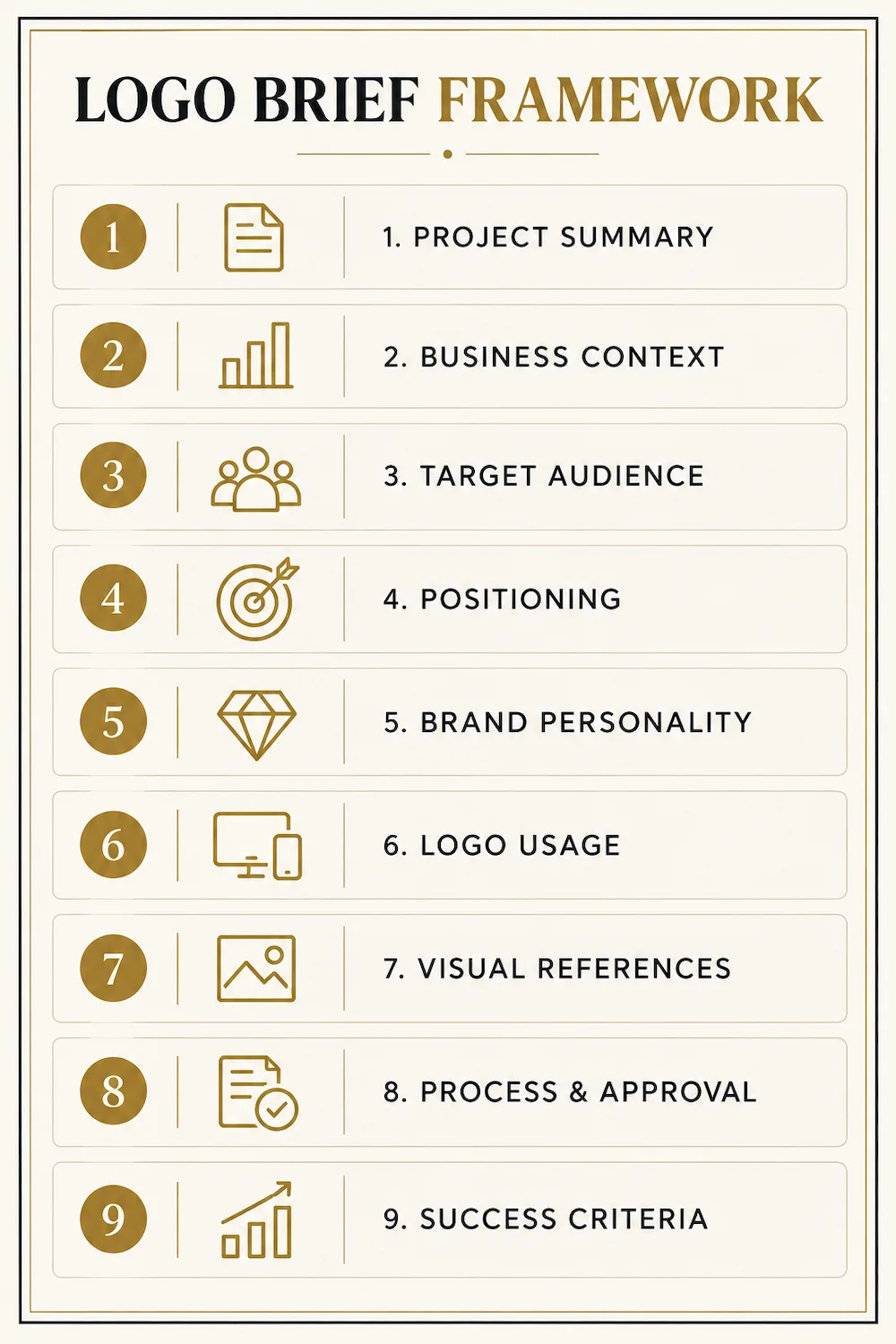
1. Project Summary
Company name: ______. Project owner: ______. Final approver: ______. In one sentence, we provide ______ for ______ so they can ______. We need a new or revised logo because ______. The most important change this project should support is ______.
2. Business And Positioning
Our main products or services are ______. Customers choose us because ______. Our direct competitors are ______. Indirect alternatives are ______. The category usually looks or communicates like ______. We should feel familiar through ______ and distinctive through ______.
3. Audience
Our primary audience is ______. They are trying to ______ and are concerned about ______. They usually encounter our brand through ______. A secondary audience that still matters is ______ because ______. The first impression we need to create is ______.
4. Brand Personality
The identity should feel ______, ______ and ______. For us, these words mean ______. It should be ______ but not ______, and ______ but not ______. The core promise the wider identity should support is ______.
5. Existing Identity
The current identity works well when ______. It fails when ______. Customers already recognize ______. Elements that must be preserved are ______. Elements that may be explored or replaced are ______. Previous design attempts taught us ______.
6. Usage And Requirements
The three priority applications are ______, ______ and ______. The smallest or most demanding use is ______. Production or accessibility constraints include ______. Required logo variations and file formats are ______. Wider identity deliverables included in the scope are ______.
7. Visual References
We admire ______ because ______. We dislike ______ because ______. Existing color or typography requirements are ______ and the reason is ______. References are intended to communicate qualities, not to be copied.
8. Process
The available budget or range is ______. The final deadline is ______ because ______. Stakeholders who provide input are ______. Feedback will be consolidated by ______. The final approver is ______. The agreed presentation and revision process is ______.
9. Success Criteria
We will consider the direction successful when it: communicates ______; feels relevant to ______; remains distinctive beside ______; performs effectively on ______; and preserves ______. Any true non-negotiables are ______.
Do not fill every blank with marketing language. Give the designer clear facts, priorities and reasons. Leave visual problem-solving to the creative process.
How Designers Turn A Brief Into Creative Direction
A designer does not simply match one answer to one visual feature. They look for relationships across the document. Audience expectations, competitor patterns, practical constraints and brand personality are considered together. The result is usually a set of design criteria rather than a literal illustration of the brief.
For example, a healthcare service may need warmth, clarity and high small-screen legibility. Competitor research may show that obvious medical crosses and pale blue palettes dominate the category. The designer might explore a more distinctive visual idea while preserving the calm structure and accessibility that help the audience feel secure. The brief informs the reasoning without specifying the final symbol.
When concepts are presented, the brief helps explain why a route exists. Typography, proportion, shape and color can be connected to the project's criteria. This produces a more valuable conversation than asking stakeholders to choose the option they like fastest. The core branding mistakes businesses should avoid often begin when strategic criteria are replaced by personal preference.
A Brief Is A Starting Point, Not A Wall
Strong designers use the brief to ask better questions. Allow relevant discovery to refine the document when new evidence appears.
Common Logo Brief Mistakes
Beginning With A Preferred Symbol
A symbol can feel like progress because it is concrete, but it may narrow exploration before the problem is understood. Explain the meaning or objective behind the idea and let the designer test whether that symbol is the strongest response.
Using Empty Adjectives
“Modern, premium and unique” creates the illusion of direction. Define each important trait, connect it to the audience and state the wrong extreme. Specific contrasts create decisions; attractive words alone do not.
Describing Everyone As The Audience
A broad customer base can exist, but the identity still needs priorities. Identify the primary decision-maker and the most important encounter. Trying to please every possible viewer often produces a cautious and forgettable result.
Copying Competitors Through References
References should identify principles such as clarity, energy or restraint. Asking for a near-copy creates legal, ethical and recognition problems. A brief must help the brand occupy its own position.
Ignoring Real-World Use
A concept cannot be judged only on a large white slide. List the priority applications and require relevant testing. The logo may need responsive variations rather than one arrangement forced into every space.
Hiding Budget Or Deadline
Designers cannot propose an appropriate process without knowing the available resources and timing. A clear range and genuine deadline lead to more comparable proposals and fewer scope disputes.
Confusing Preferences With Requirements
Personal likes are valid inputs, but they should not automatically become constraints. Label legal, technical and strategic requirements separately from ideas that the designer may challenge.
Collecting Feedback By Committee
Unstructured comments from many people create contradictory instructions. Use one owner, a defined approval path and consolidated feedback connected to the brief.
Treating The Brief As Unchangeable
The document should be approved before design, but relevant discovery may expose an incorrect assumption. Update the brief transparently when the underlying business understanding changes; do not quietly change the goal after concepts are delivered.
More Detail Is Not Always More Clarity
A long document full of repeated claims can hide the real objective. Keep evidence, priorities and constraints; remove information that does not change a design decision.
Logo Brief Approval Checklist
Review the brief with the decision-makers and designer before creative exploration begins. Every item does not need the same amount of detail, but unanswered questions that affect scope, direction or approval should be resolved.
- The business is explained in clear language a new reader can understand.
- The reason for the logo project is specific and connected to a real change.
- The scope distinguishes a logo from a wider visual identity or rebrand.
- The primary audience is prioritized and described through needs and context.
- The brand's meaningful difference is clear.
- Direct and indirect competitors are identified without requesting imitation.
- Personality traits are limited, defined and paired with qualities to avoid.
- Valuable recognition in the existing identity has been considered.
- Priority applications and demanding sizes or production conditions are listed.
- Required deliverables, formats and guideline depth are agreed.
- Visual references include reasons rather than unexplained screenshots.
- Accessibility, language and trademark constraints are documented when relevant.
- The budget supports the requested research, process and deliverables.
- The timeline includes discovery, feedback and final file preparation.
- One project owner consolidates stakeholder input.
- The final approver has reviewed the brief.
- Preferences and true non-negotiables are clearly separated.
- Success criteria can be used to evaluate concepts consistently.
- Contradictions have been discussed instead of passed to the designer.
- The brief provides direction while leaving room for creative problem-solving.
If a designer who has never met the team can explain the business, audience, objective, constraints and approval path after reading the document, the brief is ready for a discovery conversation.
Frequently Asked Questions
A logo design brief is a structured document that explains the business, audience, positioning, project objective, creative context, practical requirements and approval process for a logo project. It gives the designer enough direction to make informed decisions without prescribing the final visual solution.
Include a business overview, reason for the project, primary audience, positioning, competitors, brand personality, existing identity context, priority applications, technical constraints, deliverables, visual references, budget, timeline, decision-makers and success criteria.
There is no universal length. A focused small-business brief may take two or three pages, while a complex rebrand may need supporting research. The document is long enough when it clearly explains the decisions that affect strategy, scope, design and approval—without repeating general marketing claims.
The client or project owner should provide the business knowledge, while the designer or strategist can structure the information and ask follow-up questions. The final approver should review the brief before design begins so the team is aligned on the same objective.
No. A brand brief or brand strategy usually covers broader, long-term positioning and communication decisions. A logo brief applies the relevant business and brand context to a specific identity assignment, including practical logo uses and deliverables.
Yes. A budget or realistic range helps designers recommend the right depth of research, exploration, testing and documentation. It also makes proposals easier to compare because each designer is responding to a similar scope.
Share established brand requirements and explain the reasons behind preferences. If no system exists, describe the desired personality, audience and constraints instead of fixing the solution in advance. This gives the designer room to recommend colors and typography that serve the project.
A small, carefully explained selection is usually more useful than a large inspiration folder. For each example, identify the specific quality you like or dislike. The purpose is to clarify principles and preferences, not to choose a logo for the designer to copy.
You do not need to select a style before hiring a designer. Provide strong information about the business, audience, competitors, personality and usage. A professional designer can use that context to explore suitable visual directions and explain the reasoning behind them.
Relevant discovery may refine the brief, especially when new customer or market evidence appears. Any change should be discussed and documented because a major shift in audience, objective or scope can affect the concepts, fee and timeline.
It gives the team shared criteria before concepts arrive. Feedback can then refer to audience fit, positioning, personality and practical performance instead of relying only on taste. Revisions may still be needed, but they are more likely to move the design toward an agreed goal.
A weak brief uses vague adjectives, treats everyone as the audience, ignores applications and approval, hides scope constraints or dictates a visual solution without explaining the business problem. It may contain many words while leaving the important decisions unclear.
Key Takeaways
A useful logo brief connects business context to creative decisions while keeping the final solution open.
Begin With The Problem
Explain why the project exists and what change the new identity should support.
Prioritize The Audience
Describe customer needs, expectations and context instead of demographics alone.
Give References A Reason
Explain the quality behind every liked or disliked example and never request imitation.
Define Real Usage
Rank the applications, constraints and deliverables that the identity must support.
Clarify Approval
Name one project owner, consolidate feedback and identify the final decision-maker.
Leave Room To Design
Provide strategic direction and boundaries without deciding the visual answer in advance.
Final Thoughts
A logo brief is valuable because it converts knowledge that is scattered across a business into a shared project direction. It explains the organization, audience, market and objective before visual preferences begin to dominate the conversation.
The strongest briefs are specific without becoming prescriptive. They define the problem, identify the important constraints and show how success will be judged. They do not ask a designer to copy references or illustrate every business benefit inside one mark.
Practical details belong beside strategic ones. Usage, deliverables, budget, deadline, feedback and approval determine whether the process can run smoothly and whether the final identity will work outside a presentation. Leaving those details until the end creates avoidable risk.
Most importantly, the brief creates a better conversation. It gives the designer informed questions to ask and gives stakeholders stable criteria for reviewing concepts. When new information appears, the team can update its understanding openly instead of moving the goal without explanation.
Great logos do not begin with a favorite color, a fashionable style or a screen full of sketches. They begin when the business and designer understand the same problem—and agree on what the identity must be ready to do.