
- Most Common Branding Mistakes
- 1. Unclear Positioning
- 2. Appealing To Everyone
- 3. Treating The Logo As The Brand
- 4. Copying The Category
- 5. Inconsistent Touchpoints
- 6. Changing Too Often
- 7. Chasing Trends
- 8. Undefined Brand Voice
- 9. Unsupported Claims
- 10. Weak Internal Alignment
- 11. Ignoring Customer Experience
- 12. Ignoring Accessibility
- 13. Rebranding Without Diagnosis
- 14. Measuring The Wrong Outcomes
- 15. Missing Brand Governance
- Brand Repair Framework
- Brand Audit Checklist
- Frequently Asked Questions
- Final Thoughts
What Are The Most Common Branding Mistakes?
The most common branding mistakes are unclear positioning, trying to appeal to everyone, treating a logo as the entire brand, copying competitors, inconsistent customer touchpoints, frequent redesigns, trend chasing, an undefined voice, unsupported promises, weak internal alignment, disconnected customer experience, inaccessible communication, premature rebranding, vanity-led measurement and missing brand governance.
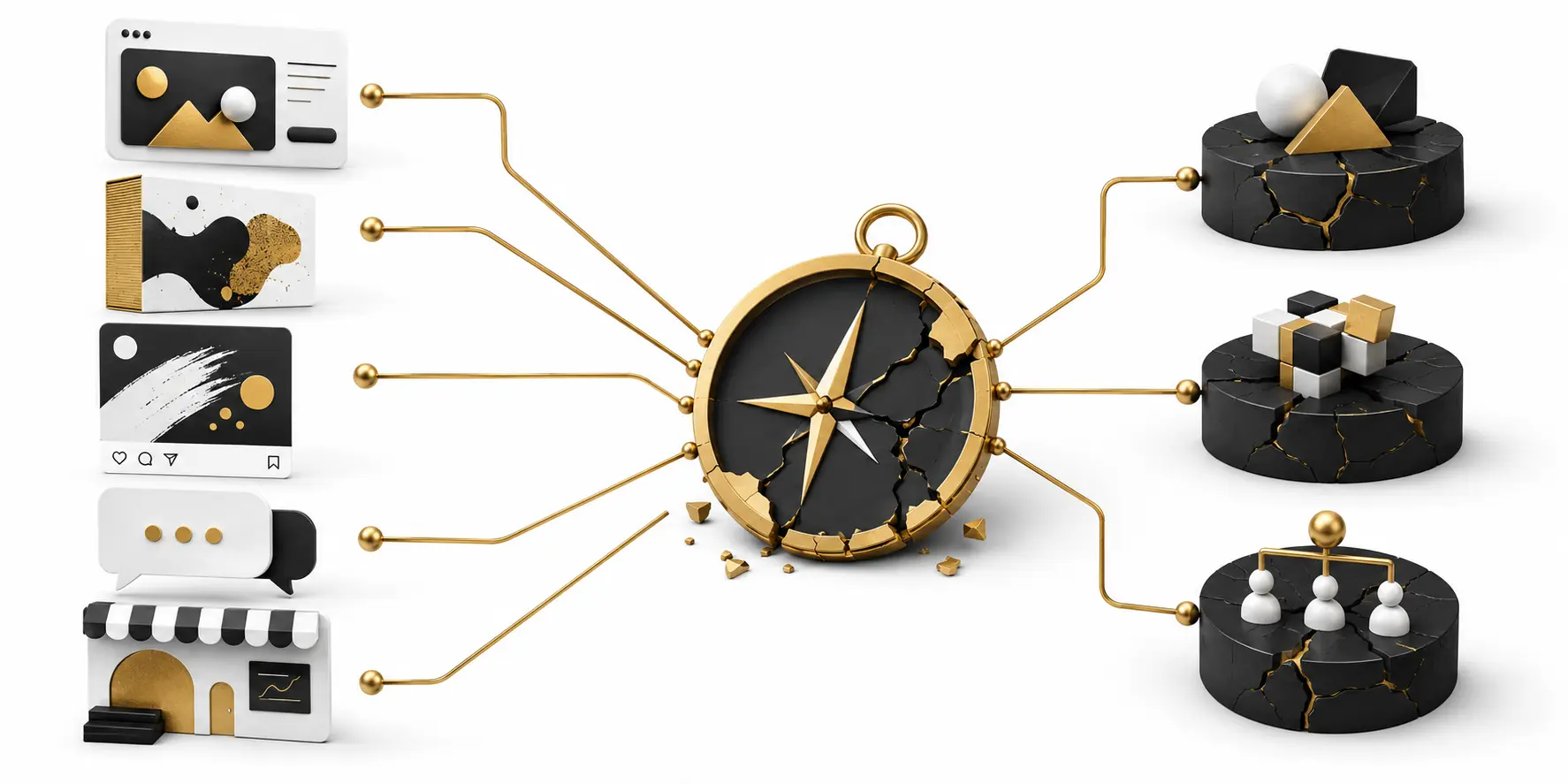
These errors make a business harder to understand and remember. They also compound. Unclear positioning produces vague messaging; vague messaging encourages random campaigns; random campaigns create inconsistent visual choices; and inconsistency weakens the memory cues customers need to recognize the business later.
Fixing branding does not always require a new name, logo or website. In many cases the better solution is to identify the root problem, define a clearer strategic decision and align existing assets around it. This guide helps you separate visible symptoms from the system that created them.
The Most Expensive Branding Mistakes Are Repeated Decisions
A weak social post is temporary. An unclear positioning statement, an undefined brand voice or an inconsistent approval process can produce hundreds of weak assets. Repair the decision system before redesigning its outputs.
1. Operating Without Clear Brand Positioning
Positioning defines who the business is for, which problem it is best equipped to solve, what alternative it competes against and why its approach is meaningfully preferable. Without those decisions, branding becomes a collection of attractive statements that could describe almost any company.
The warning signs are easy to recognize: the homepage opens with broad claims such as "quality solutions," sales teams describe the company differently, and marketing changes direction whenever a competitor launches something new. Customers may understand the category but still have no reason to choose or remember the business.
2. Trying To Appeal To Everyone
Businesses often widen their message because they fear excluding potential customers. The result is usually a brand that excludes nobody but motivates nobody. Different audiences value different outcomes, respond to different evidence and interpret the same tone in different ways.
A defined audience does not mean refusing every other buyer. It means choosing whose needs shape the primary message. A restaurant can welcome families and professionals while still deciding whether its core experience is fast convenience, regional authenticity, premium dining or social discovery.
Prioritize One Buying Situation
Define the moment in which your ideal customer should think of the brand. Specific buying situations produce clearer messages than broad demographic labels alone.
3. Treating The Logo As The Entire Brand
A logo is an identification cue, not a complete customer experience. It cannot define service standards, product quality, pricing logic, messaging, photography, interface behavior or the way employees respond to a problem. When a business invests only in the mark, the remaining touchpoints improvise.
This mistake often appears after a redesign. The new logo is launched, but proposals use old typography, social posts introduce random colors, packaging follows a different tone and customer support sounds unrelated to the marketing. The logo changed; the system did not.
The fix is to translate strategy into a repeatable identity: logo rules, typography, color, imagery, layouts, voice, core messages and customer-experience principles. Our Building A Visual Identity guide covers that system in depth without repeating it here.
4. Copying The Category Instead Of Building Distinctiveness
Category conventions help customers understand what a business offers, but copying every convention creates visual and verbal sameness. Technology companies begin using identical gradients; financial brands repeat the same shield; wellness businesses select the same leaf; and everyone claims to be innovative, trusted and customer-focused.
Distinctiveness does not require rejecting every familiar cue. The better approach is to keep the cues that support comprehension and introduce a consistent feature the brand can own. That feature might be a silhouette, phrase, layout behavior, sonic cue, illustration style or recognizable way of explaining the category.
Branding Symptom vs Root Cause
| Visible Symptom | Likely Root Cause |
|---|---|
| Marketing looks different every month | No approved identity system or governance |
| Customers compare only on price | Positioning does not communicate a meaningful difference |
| The brand resembles competitors | Category conventions were copied without a distinctive cue |
| Teams explain the offer differently | Messaging and audience priorities were never defined |
| A redesign fails to improve results | The visible identity changed while the underlying experience stayed weak |
5. Presenting A Different Brand At Every Touchpoint
Customers do not divide a business into departments. The website, sales call, invoice, packaging, social post and support interaction all contribute to one judgment. If each touchpoint uses different visual rules, promises and levels of quality, the customer must repeatedly work out whether the experiences belong together.
Consistency is not mechanical repetition. A mobile interface and a trade-show booth should not be identical; they should feel related. The same hierarchy, language, distinctive cues and promise should adapt to the purpose of each environment.
For the detailed recognition and implementation principles, continue with Why Brand Consistency Matters. In this audit, focus on finding the touchpoint that creates the greatest break in the customer journey and repair that first.
6. Changing The Brand Before Recognition Has Time To Build
Internal teams see the brand every day and become bored long before customers become familiar with it. This exposure gap can make a stable identity feel old to employees while it is only beginning to become recognizable in the market.
Frequent redesign changes the cues customers use for retrieval. New colors, symbols, phrases and photography may each look better in isolation, yet constant replacement prevents any one system from accumulating memory. Evolution should protect the strongest distinctive assets unless research shows they create a genuine problem.
Your team experiences the brand daily. Many customers experience it occasionally. Do not mistake internal boredom for external fatigue.
7. Chasing Trends Without A Strategic Reason
Trends can reveal new production methods, cultural preferences and interface expectations. The mistake is adopting a style because it is visible rather than because it supports the brand's position and audience. When many businesses follow the same trend simultaneously, the style may reduce differentiation at the moment it appears most current.
Before adopting a trend, ask whether it improves clarity, usability or relevance; whether it will work across the brand's real applications; and whether it strengthens or hides existing recognition. If the only reason is “everyone is doing it,” the decision belongs to fashion rather than strategy.
Modern Is Not A Position
“Modern” describes a temporary appearance, not a reason to choose the business. A useful brand decision connects style with audience, category, promise and proof.
8. Communicating Without A Defined Brand Voice
Voice is the consistent character behind the language; tone is how that character adapts to a situation. Without clear voice principles, a business may sound playful on social media, formal in sales material, technical on the website and defensive in support conversations.
Avoid vague instructions such as “sound premium” or “be friendly.” Define observable choices: sentence length, vocabulary, level of technical detail, humor boundaries, formality, point of view and phrases the brand should avoid. Include examples for routine situations such as an announcement, an error, a complaint and a sales explanation.
9. Making Brand Promises The Business Cannot Prove
Claims such as best, fastest, most trusted or highest quality feel powerful because they sound decisive. Without evidence, they create skepticism and make the brand interchangeable with every competitor using the same language.
Replace inflated claims with specific value and proof. Explain the process, standard, credential, comparison, guarantee or customer outcome that makes the promise believable. If proof is unavailable, change the claim before increasing promotion.
This is also a trust issue. A polished visual identity raises expectations; the product and service must fulfil them. Branding should clarify the value the business can consistently deliver, not decorate an experience it cannot support.
10. Building A Brand Employees Cannot Use
A brand system fails when only the marketing team understands it. Sales, recruitment, leadership, product, customer support and external partners all make decisions that affect perception. If the strategy is too abstract or documentation is difficult to access, people will improvise under pressure.
Internal alignment requires more than sending a guideline PDF. Teams need role-specific examples, usable templates, short decision rules and a clear approval path. They also need to understand why the choices matter, because rules followed without context are abandoned as soon as an unusual situation appears.
Employees Translate Strategy Into Experience
Customers experience the brand through decisions made by people. Training, tools and incentives must support the same promise communicated by marketing.
11. Separating Branding From Customer Experience
Branding is often treated as the layer placed on top of a product. Customers experience it more broadly: how quickly they find information, whether pricing is understandable, what happens after payment, how problems are resolved and whether the business behaves as promised.
Map the full customer journey and compare each stage with the intended position. A brand promising simplicity should not require a confusing onboarding process. A premium brand should not send careless documents. A transparent brand should not hide important conditions until checkout.
The fix may be operational rather than visual. Improve the confusing step first, then make the identity and communication accurately represent the stronger experience.
12. Ignoring Accessibility And Practical Usability
A brand cannot be clear if important information is difficult to read, navigate or understand. Low contrast, tiny text, color-only instructions, inaccessible forms and decorative typography can exclude users and weaken communication for everyone.
Accessibility should be built into the identity and component system rather than checked at the end of a campaign. Establish contrast combinations, readable type sizes, focus states, alternative text practices and rules for captions and motion. The W3C Web Content Accessibility Guidelines provide the technical reference for digital experiences.
13. Rebranding Before Diagnosing The Real Problem
A decline in leads, engagement or employee enthusiasm can make rebranding feel like a decisive solution. Those symptoms may come from pricing, distribution, product fit, service quality, market change or unclear measurement rather than the identity itself.
Begin with evidence. Review customer interviews, search behavior, support themes, sales objections, competitor movement and performance by journey stage. Identify which perception must change and whether the current brand genuinely prevents that change.
If a rebrand is necessary, define what should be preserved as carefully as what should change. Recognition is an asset. Removing every familiar cue can make a business look new while discarding memory it already paid to build.
14. Measuring Marketing Activity Instead Of Brand Outcomes
Post frequency, impressions and follower counts describe activity or exposure. They do not show whether the intended audience understands the position, recognizes the brand, remembers the right message or considers it in a buying situation.
Use a small set of repeatable measures connected to the objective: unaided awareness, aided recognition, message association, branded search, direct traffic, repeat purchase, preference, consideration or share of relevant search demand. Choose only metrics the team can interpret and act upon.
Measurement should compare change over time using a consistent method. A one-time survey gives a snapshot; a tracking system reveals whether strategic decisions are improving the desired outcome.
15. Creating Guidelines Without Brand Governance
Guidelines explain the system. Governance keeps it usable. Without ownership, templates become outdated, exceptions multiply, external partners receive different files and nobody knows who can approve a new pattern.
Define where current assets live, who owns the system, how requests are reviewed, which decisions teams can make independently and how new components enter the library. Schedule periodic reviews so the brand can evolve through evidence rather than emergency redesign.
Governance should reduce friction. If following the brand takes longer than bypassing it, teams will build unofficial alternatives. Make correct assets easier to find and use than incorrect ones.
A Five-Step Framework For Repairing A Weak Brand
Diagnose
Collect customer evidence and separate visible symptoms from underlying causes.
Define
Clarify audience, positioning, promise, proof and the distinctive cues to protect.
Align
Connect identity, messaging and customer experience around the same decision.
Document
Create accessible rules, templates, examples, ownership and approval paths.
The fifth stage is measurement. Choose a baseline before implementation, track the outcome the repair is intended to change and review whether the system works for both customers and internal teams. If results do not improve, revisit the diagnosis rather than immediately redesigning again.

Common Branding Mistakes Audit Checklist
Use this checklist to identify priorities. Do not treat every unchecked item as a reason to rebrand. Look for clusters that point to the same root cause.
- We can name the primary audience and buying situation.
- Our positioning explains a meaningful, credible difference.
- Teams describe the offer using the same core message.
- Our identity contains distinctive cues customers can recognize.
- Website, sales, product and support feel like one company.
- Voice principles include practical examples and boundaries.
- Important claims are supported by evidence.
- The customer experience fulfils the promise communicated by marketing.
- Digital touchpoints follow accessibility and usability standards.
- Current assets, templates and guidelines are easy to find.
- Ownership and approval responsibilities are clear.
- Brand outcomes are measured consistently over time.
- Changes protect established recognition unless evidence supports removal.
- External partners receive the same current system as internal teams.
- Exceptions are documented and reviewed instead of becoming permanent accidents.
Strong branding is not perfect consistency. It is consistent decision-making around a clear promise.
Frequently Asked Questions
The most damaging mistake is operating without clear positioning. When the audience, value, difference and proof are undefined, visual identity, messaging and campaigns become inconsistent outputs of an unclear strategy.
Warning signs include customers misunderstanding the offer, teams describing it differently, marketing resembling competitors, inconsistent touchpoints, price-led comparison and poor recall of the company name or distinctive cues.
No. Visual inconsistency may be a symptom of unclear positioning, missing ownership, outdated templates or disconnected departments. Diagnose the decision system before correcting individual assets.
Not necessarily. Clearer positioning, messaging, templates, customer experience and governance may solve the problem while preserving existing recognition. Redesign only when evidence shows the current identity prevents the required change.
Competitor cues can help explain the category, but copying their complete visual and verbal language removes the distinctive signals customers need to identify and remember one business.
There is no universal schedule. Rebranding should respond to a meaningful change in strategy, audience, market structure or identity performance—not internal boredom or a temporary design trend.
Start with positioning and the highest-impact customer touchpoint. Clarify who the brand serves and why it is preferable, then repair the place where customer confusion most directly affects discovery, evaluation or purchase.
Create usable guidelines, templates, role-specific training, clear ownership and a simple approval process. Review the system regularly and measure whether customers still connect the intended messages and cues with the brand.
The right metrics depend on the objective, but useful options include unaided awareness, aided recognition, message association, branded search, consideration, preference, repeat purchase and direct traffic. Use a consistent method so change can be tracked over time.
Key Takeaways
Most branding mistakes are symptoms of unclear decisions, weak alignment or missing ownership rather than isolated design failures.
Diagnose Before Redesigning
Use customer and operational evidence to identify the root cause before changing visible assets.
Choose Who The Brand Is For
Specific audiences and buying situations produce clearer positioning and more relevant communication.
Align Promise And Experience
Marketing, identity, product and service should reinforce one credible expectation.
Make Consistency Operational
Guidelines need owners, templates, training, approval paths and measurement to remain useful.
Final Thoughts
Businesses rarely become forgettable because of one poor design. They become forgettable when unclear decisions are repeated across many customer interactions. The message changes, the identity shifts, the promise remains vague and each department presents a slightly different company.
The solution begins with clarity. Define the audience, buying situation, position, promise and proof. Protect the distinctive cues customers already recognize. Align communication with the experience the business can actually deliver, then make the system easy for employees and partners to use.
Branding should reduce confusion for customers and decision-making friction for teams. When both groups understand what the business stands for and how that promise appears in practice, consistency becomes a natural outcome rather than a visual policing exercise.
Audit the system, repair the root cause and measure whether perception changes. That disciplined process builds stronger recognition than another redesign launched without a diagnosis.